-1.png)
 You can’t read the label from inside the jar.
Name someone on your marketing team who understands the business better than anyone else. Take your time.
Nobody. Not your agency, not your board, not the consultant who parachutes in twice a year. Your internal team has forgotten more about your customers, your margins, and your history than an outsider will ever learn.
That very depth is exactly why they're the last people positioned to catch what's shifting outside the business. Every signal from the wider market gets read through the roadmap they already own, and own well. A shift that doesn't fit the current plan doesn't look like a shift. It looks like noise. The people reading that signal are sharp. They are simply standing exactly where a blind spot naturally forms, and no amount of talent fixes that on its own.
The blind spot nobody assigned
Nobody sat down and decided that watching the outside world would be nobody's job. It just worked out that way. Your marketing team is busy running the plan, and running the plan is a full-time commitment that gets more demanding, not less, as the team gets better at it.
That's the part that sneaks up on you. The better your team gets at its actual job, the closer it stands to the jar, and the harder the label gets to read from in there. It compounds quietly. A blind spot is, by definition, the thing nobody notices getting bigger.
Think about the last time a genuinely new community formed around your category, or a competitor quietly rerouted budget into a channel everyone had written off the year before. By the time either one showed up in a slide, it had already been true for months.
Call it the Blind Spot Check. Ask yourself three questions and see how fast the answers come.
|
Ask yourself |
If you hesitate |
|---|---|
|
What changed in your category last quarter that nobody was actually assigned to notice? |
That's the blind spot, not a memory problem |
|
When did you last read a competitor's move without your own assumptions already colouring how you saw it? |
If you can't remember, nobody's been checking |
|
If an outside signal flatly contradicts your plan right now, is there anyone on the marketing team with the time to catch it before the quarter ends? |
If the answer's no, nobody has the distance to read it yet. |
For most teams, the honest answer to all three is a shrug, and that shrug is the blind spot. It isn't a character flaw in whoever's answering.
This particular blind spot works differently from a normal execution gap. Every company in your category built its team the same way, for the same reasons, and left nobody with the distance to see it coming. So when a shift happens outside the walls, it doesn't just surprise you. It surprises almost everyone in the category at roughly the same time, which makes it feel like bad luck instead of a pattern.
That's the compounding part. The better every team in the category gets at running its own plan, the more confident everyone feels, and the less anyone questions whether the plan is still aimed at the right thing. Confidence and blindness grow together, which is exactly backwards from what you'd want.
By the time a shift is obvious enough for an internal team to catch it without looking for it on purpose, it has usually already cost someone a real chunk of committed budget. The category doesn't get surprised because nobody was smart enough to see it coming. It gets surprised because nobody's job was to be looking before it arrived.
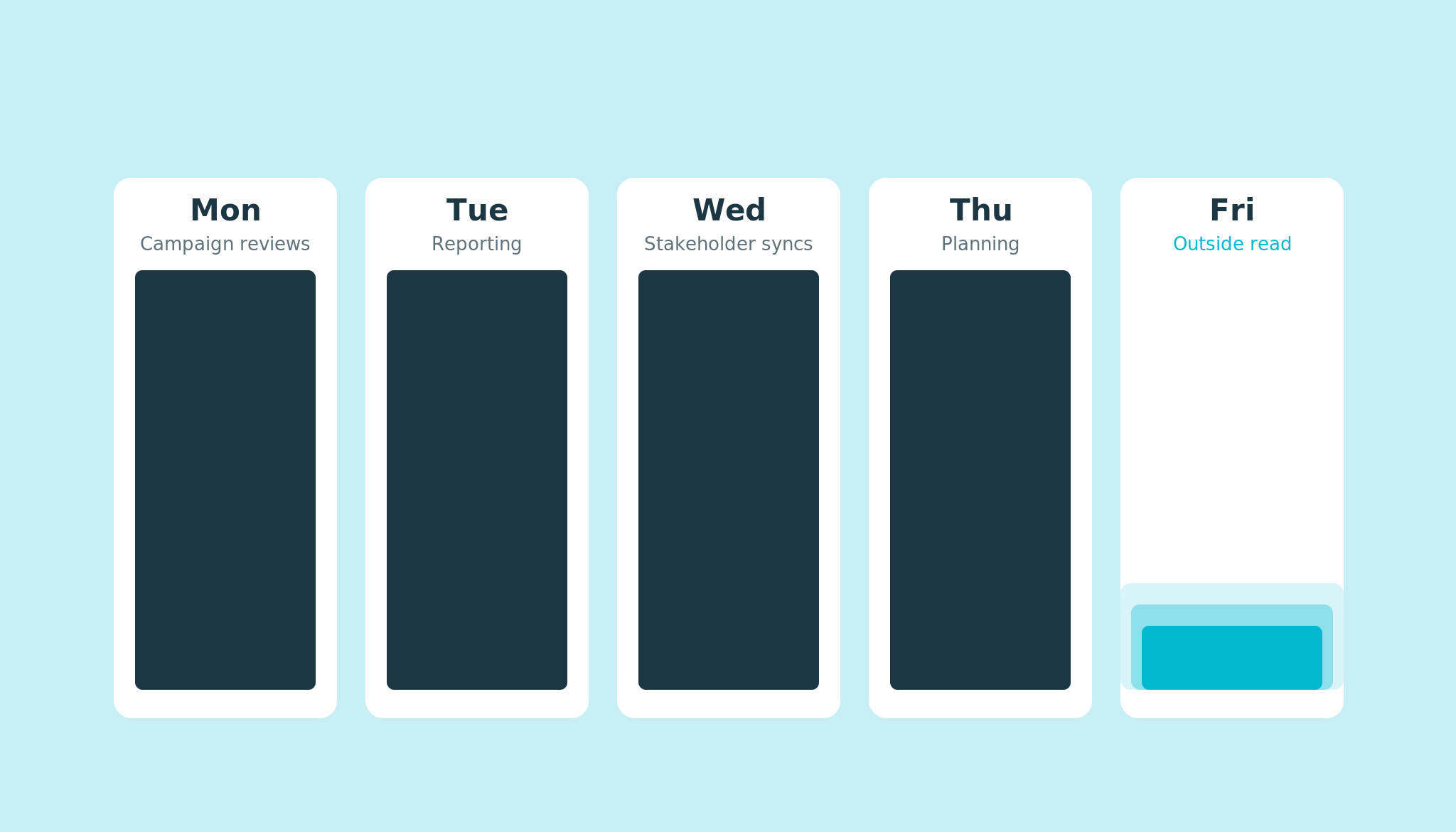 The calendar of the person who's supposed to know what's happening outside.
Look at your own week, or your team's. Block off every meeting, every deck, every stakeholder check-in, every hour spent keeping the current plan moving. Then look for the block where someone was simply watching what's happening outside the business, with no agenda tied to the current roadmap. For most teams, that block barely exists on the calendar. People care. Nobody was ever handed the time.
Watching outside is a different job than running the business
This was never a talent gap. Your team has the talent. What it doesn't have is the distance to actually read the label.
A few things separate a real outside read from what an internal team can do on the side, even a sharp one, and the difference has less to do with tools than with position.
It runs on a schedule, not a scare. A dedicated read tracks what audiences are drawn to, what's earning attention in the category, and where competitors seem to be spending, continuously, so the shift shows up while it's still small.
It starts with no stake in being right. Your internal team reads every signal through the plan it already built and already believes in. An outside read has no investment in last year's roadmap being correct, which is exactly what lets it notice when the roadmap is wrong.
Your team has spent months making the current plan work, and that's not a flaw, it's what a good team does. But it also means the roadmap has become something worth defending, even unconsciously, and a shift that undercuts it gets read charitably right up until it can't be ignored anymore. An outside read doesn't inherit that instinct. It has nothing invested in last quarter's plan being the right call, so it can say the uncomfortable thing a month earlier than anyone inside the plan would let themselves say it.
It triangulates instead of reacting to one loud thing. A competitor's visible campaign means a lot more once you can also see that audience affinity and unprompted sentiment are moving the same direction. One signal is a headline. Three signals agreeing is a finding.
Picture a competitor launching a splashy campaign. On its own that's just a headline, the kind of thing that shows up in a recap deck and gets forgotten by Friday. It means something different once you can also see that a specific audience segment's affinity for that competitor has been quietly climbing for two months, and that unprompted mentions of them in the communities your buyers actually trust have picked up at the same time. One signal alone is noise. Three signals moving together, on their own timelines, are a pattern worth acting on.
Call it signal strength. The more independent signals point the same way, the more it's worth acting on.
|
What it is |
What to do |
|
|---|---|---|
|
One signal |
A headline |
Note it, don't act on it alone |
|
Two independent signals |
A pattern worth watching |
Start paying closer attention |
|
Three or more independent signals |
A finding |
Bring it to the next planning meeting |
It reports the delta, not the dashboard. The value is a clear answer to what changed, and what that change means for the call you're about to make, not another summary of what your team already lives inside.
 Most signals confirm the plan. The useful one arrives on its own schedule.
Most weeks, every signal your team sees confirms the plan it's already running, which feels like progress right up until the one signal that would have changed something never gets a turn to speak.
Once the outside read has real distance instead of borrowed attention, the pattern changes. A competitor's move stops landing as a surprise in a leadership meeting, because someone had already been watching for it. A shift in what your audience is drawn to shows up as a heads-up two months early instead of a scramble after the fact. And the next time someone asks what changed outside the building this quarter, somebody in the room actually has an answer.
What to actually do about it
You don't need to rebuild your marketing team to close this gap. You need to build in that distance deliberately, the way you'd staff any other function that matters.
Put a name and a cadence on it, so category shifts land as a briefing instead of a surprise in a leadership meeting. It doesn't need to be a big function to start, just someone whose job includes actually watching, on a schedule nobody can deprioritize when the quarter gets busy.
Bring one outside finding to every planning meeting, something your internal team, heads down in the work, couldn't have surfaced on its own. If nobody has one to bring, that's the signal nobody has the distance yet.
Once a cycle, pressure-test your roadmap against what the outside read is showing, and write down what you'd actually change if you took it seriously. Most quarters that won't mean an overhaul, just a confirmation that the plan is still aimed at something real.
Before any external signal drives a decision, check it against a baseline. "It's trending" means nothing until you know what normal looks like, and a lot of expensive decisions get made on exactly that kind of vague momentum.
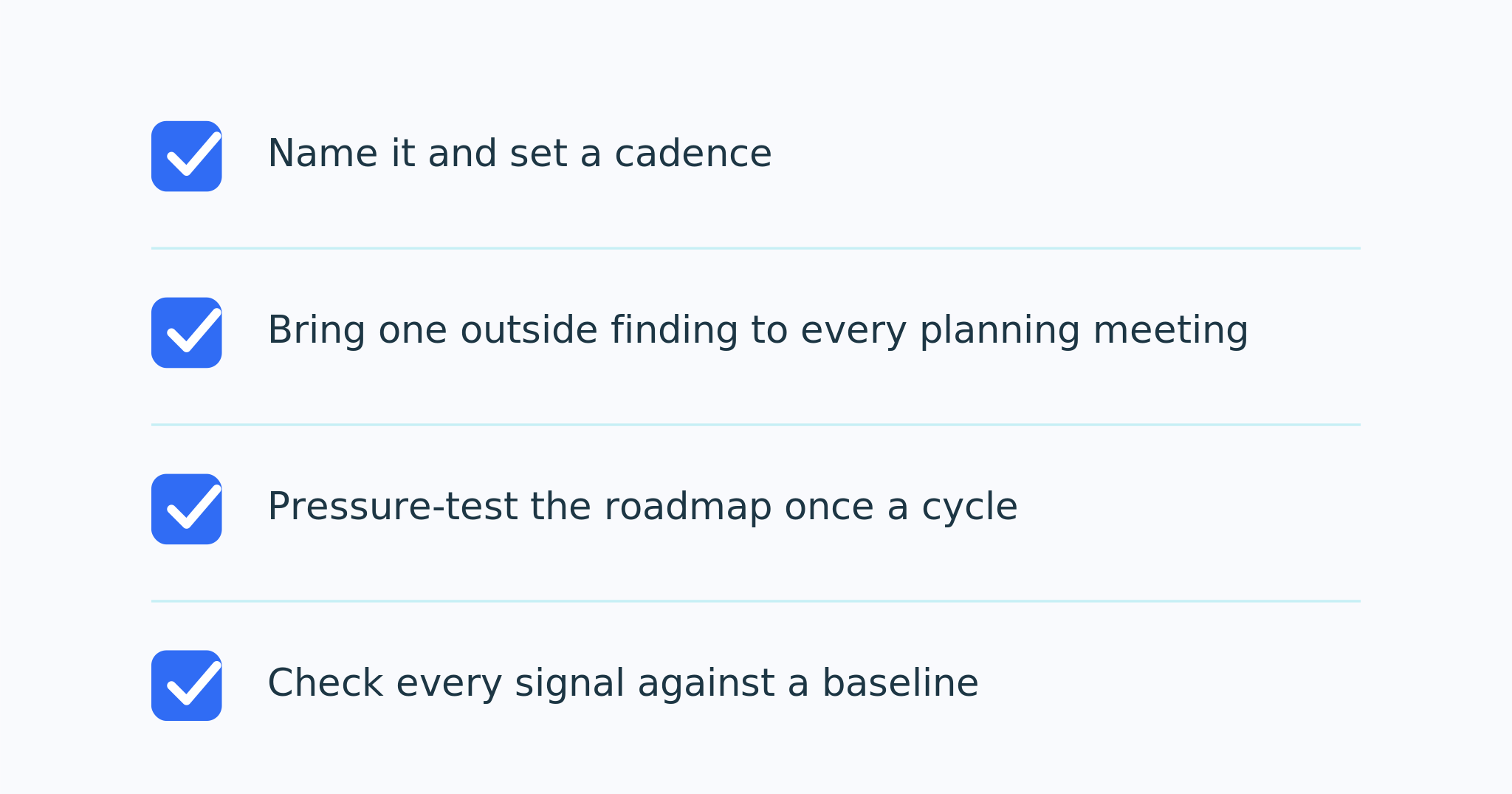
Four habits. Not a bigger team.
None of this requires a bigger team or a bigger budget. It requires deciding that watching the outside is somebody's actual job, on the calendar, with a name next to it, instead of the thing everyone agrees matters and nobody has time for. Most teams already agree this matters. Agreement was never the missing piece.
You already know what's happening inside the jar better than anyone. You can see why the label is unreadable from where you're standing. Knowing exactly where to point the read, every week, without your own roadmap tilting what you see, is the part we do for you.
Trying to make a big call and wondering what the market's already told you that you haven't heard yet? That's the work we do. Book a chat and find out.
.png)