.png)
Assign someone to read the market and turn signals into a call, because your tools only hand you feeds and that seat sits empty.
Something’s trending on TikTok. Your team makes your version of it. Sometimes it pops, sometimes it dies, and either way you can’t really say why.
Here’s the part nobody says out loud. You have every tool built for this. The dashboards, the ad library, the analytics, the social listening. You can see what everyone posted and what already happened on your own channels. And you’re still choosing what to make next, where the budget goes, which audience to chase, on taste. Reacting to what looks good and hoping it works.
You have more data than any marketing team in history, and you still can’t answer the one question that actually matters. What’s your audience about to do, and what should you do about it.
That’s not a tool problem. The tools are doing exactly what they were built to do.
A telescope isn’t an astronomer
You can own every instrument ever built and still not be able to read the sky. Owning the telescope was never the hard part. Knowing where to point it, and what that smudge of light actually means, is the whole job.
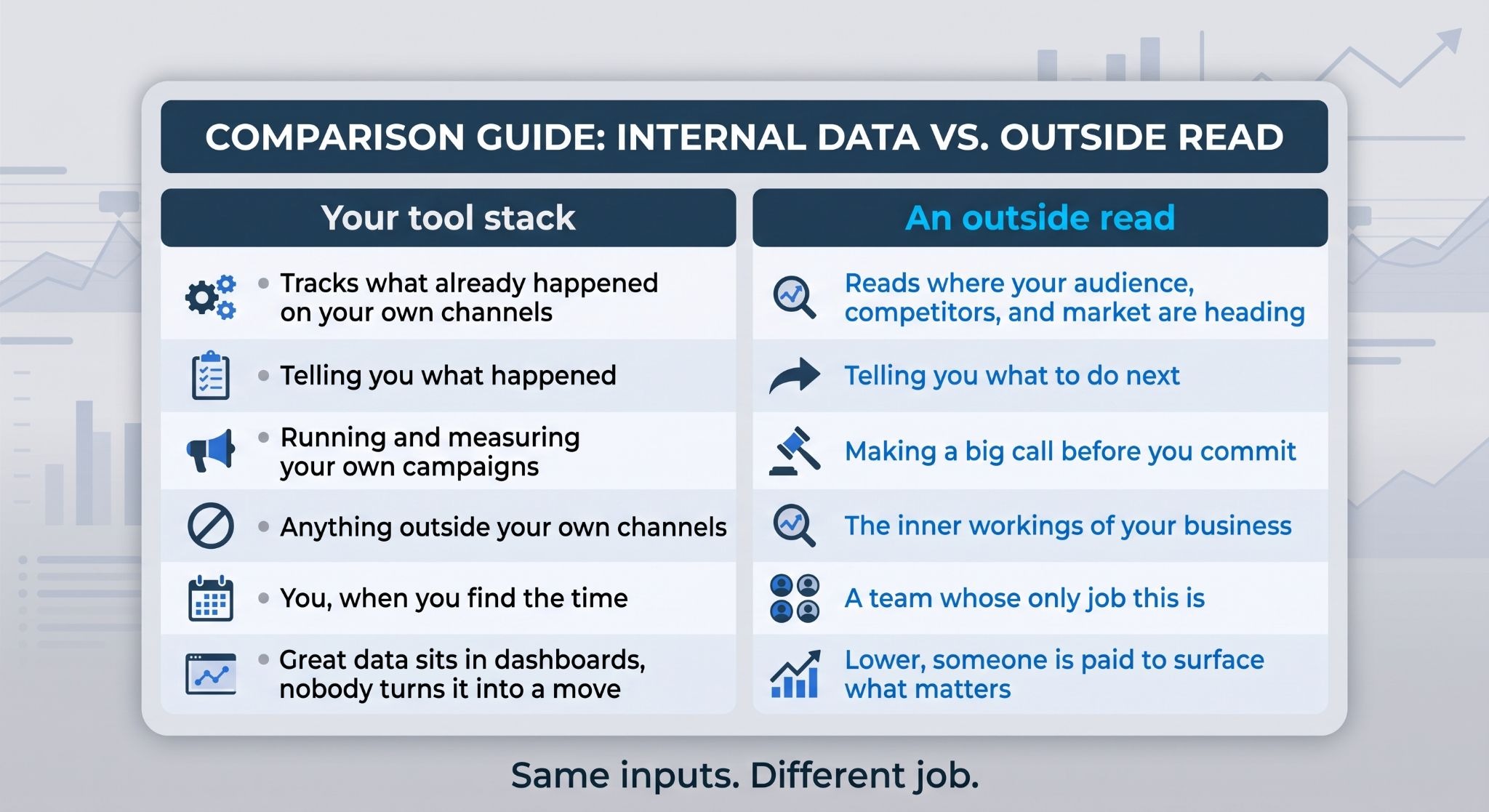
Your stack is the same. Every tool in it is a good instrument. One scans the web for your mentions. One reads sentiment across your market. One estimates your competitors’ traffic. One grades your owned content. One tells you what people did once they landed on your site. Some watch your own channels. Some watch the wider market. That is not the problem. The problem is what every one of them does at the end. It hands you a feed and stops.
None of them answers the question you were actually asked. Who is my audience really following right now. What is my competitor quietly putting money behind. Which community is forming around my category before anyone in it notices. The pieces of those answers are scattered across your tools. What no tool does is pull them together and tell you what to do.
It helps to know why that is, because the tools aren’t the flaw either. A dashboard is built to measure one thing and measure it well. That’s a narrow job, done properly. Reading a market means holding six of those narrow jobs in your head at once, noticing where they agree, and deciding what the agreement means for the call you’re actually making. Nobody built a tool for that kind of judgment, and judgment doesn’t come installed.
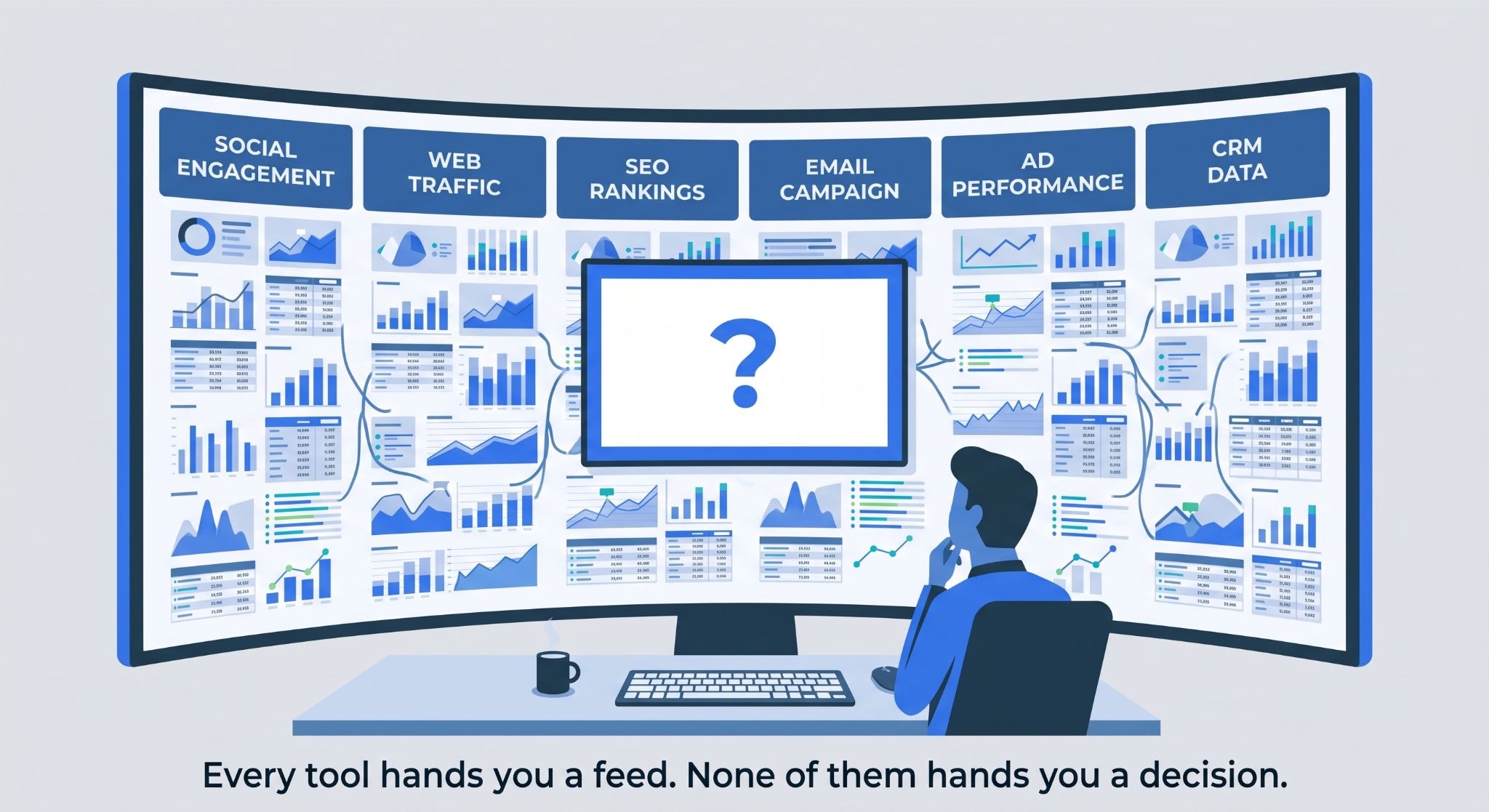 There is a quieter cost on top of that. Most of the stack you are paying for barely gets touched. You bought the whole toolbox and you reach for two wrenches. Your team is not lazy. Reading all of it, and turning it into a decision, is a full-time job that nobody was ever given.
The seat nobody filled
Think about everyone who touches your strategy. Your team knows the business cold. Your agency makes the work and runs it at scale. Your analysts measure it after the fact. Your tools track the numbers. Every one of those seats is filled by someone doing real work.
Now, whose job is it to sit with all of it, the feeds, the market signals, the competitor moves, and turn it into a call. Not a tool that pings you when a number changes. A person whose whole job is to read what the market is doing and tell you what to do about it.
That seat is empty. For most teams it has been empty for years. Nobody left it open on purpose, but nobody assigned it either. So the question of what the market is actually doing got answered by assumption, a stale industry report, or a plain guess. And that guess is sitting quietly underneath your most expensive decisions.
Here is what that looks like. You can watch every competitor ad in the public library and still have no idea what any of them are actually spending, or which deals they are quietly closing. The market keeps moving, and you only find the move that mattered once it is already done. The tools were fine. What was missing was anyone whose whole job was to pull it together and make the call.
It shows up in smaller ways too, more often than the one big miss. A creator starts pulling real weight in your category and nobody on your team notices for two months, because tracking that wasn’t anyone’s job either. A competitor quietly shifts spend into a channel you wrote off last year, and you find out from a screenshot a colleague forwards you, not from anything you own. Neither of those needed better software. Both needed someone whose whole job was to be looking.
Why this keeps happening at the category level
Here’s the part that’s easy to miss from inside your own team. Every company in your category bought roughly the same tools, for roughly the same reasons, and left roughly the same seat empty. So everyone is reading the same lagging indicators, at the same time, and reacting to the same things a quarter after they mattered.
That’s why category strategy tends to converge. Everyone is working from the same kind of rear-view mirror, and a rear-view mirror only ever points one direction. The convergence isn’t deliberate, it’s just what happens when a whole category reads the same lagging data at the same time. The brand that reads the road ahead instead of the road behind gets to move first, and moving first is worth more than moving with slightly better data.
How to actually read the market
Another login will not fix this. It is a way of working, and you can start most of it this week.
Start from the decision, not the dashboard. Name the call you are actually trying to make first, budget, channel, creative direction, whatever it is. Then pull only the signals that can actually move that specific call. Most teams do the opposite. They open every dashboard first and hope a decision falls out of the pile. It rarely does.
Read several independent signals side by side. Who your audience is genuinely drawn to, not just what they’ve heard of. What content is actually earning attention in your space right now. What your competitors appear to be funding, judged by where they actually show up rather than what they say in a press release. What people say about your category when nobody is asking them a survey question. Any one of those signals can lie to you on its own.
Cross-check them against each other until the story holds. A pattern in one dashboard is a hunch. A pattern that shows up the same way across three independent views is a finding, and a finding is something you can actually put budget behind.
And watch the trap that catches most teams here. The easiest chart to read is not the most honest one. A tidy, high-volume metric feels safer to act on than a smaller, spikier signal that’s actually predictive. Weight a signal by how hard it would be for a competitor to fake or game, not by how clean the chart looks in a deck.
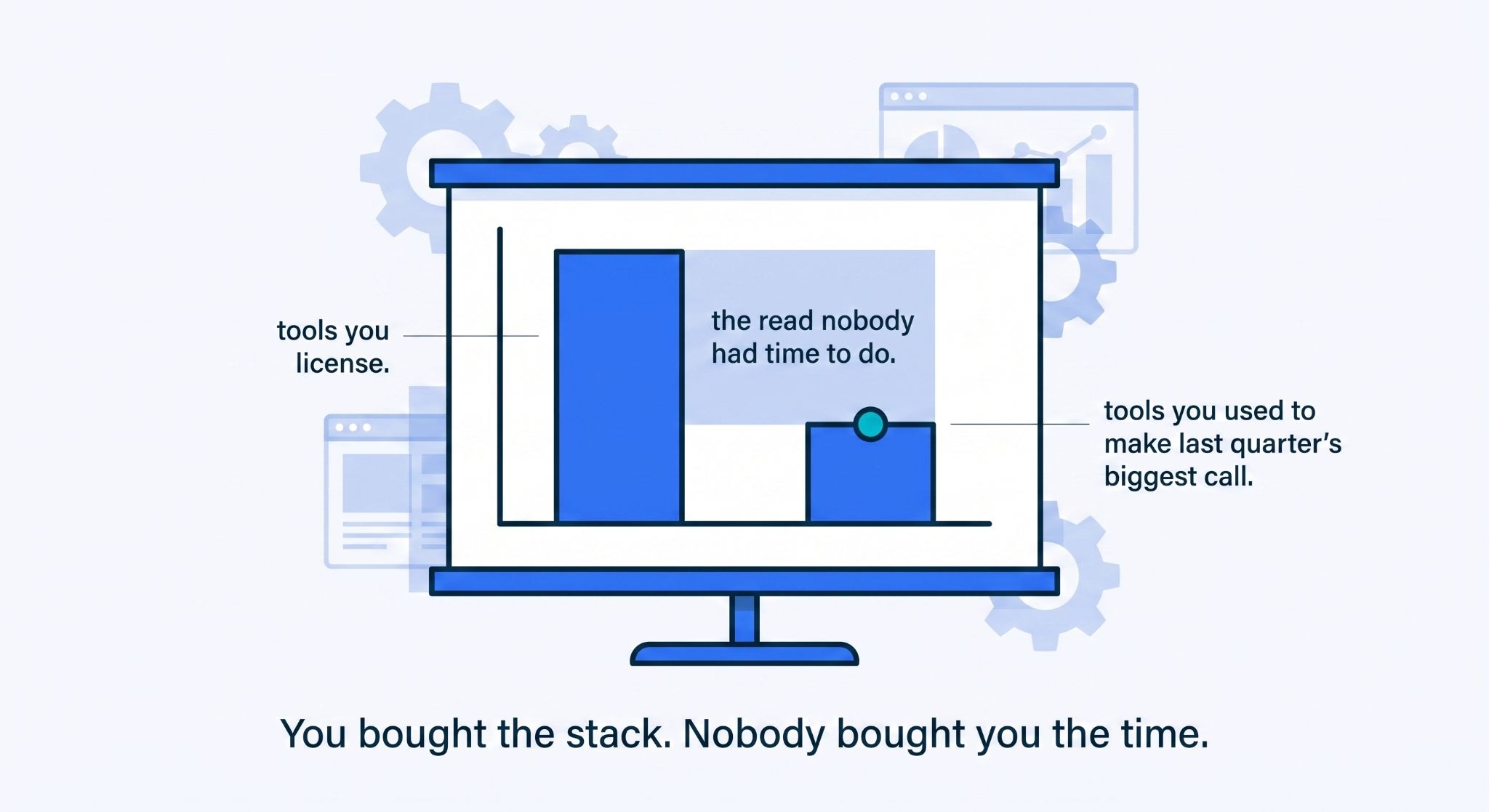 Here’s what changes once someone actually owns this, instead of everyone owning a slice of it. The next competitor move stops being a surprise you hear about from a screenshot, because someone was already watching for it. The next channel bet stops being a guess dressed up in a deck, because it’s backed by signals that agreed with each other before you spent a dollar. And the next time your CMO asks what your audience is actually doing right now, the room doesn’t go quiet.
Try this on Monday
Take the biggest call on your plate this quarter. Write down the one decision you are truly trying to make, not the general topic, the actual decision you have to defend in a room.
Then ask what is happening in the market right now that would change your answer. Not what happened last quarter. What’s true this week.
Notice, honestly, whether any tool you already own is going to hand you that answer. For most teams it won’t, because that was never the job those tools were built for. Someone has to read it, cross-check it against something else, and turn it into a call you can actually stand behind.
The next time someone in that room asks what your audience is actually doing right now, you can be the one with an answer. And it will be because someone finally had the time to read the market and turn it into a call, not because a new dashboard showed up.
You have the tools. Now get the read.
Got a big call coming up? Reading the market before you make it, and turning that read into a decision instead of another dashboard, is the work we do. If that’s the call you’re staring at, book a chat.