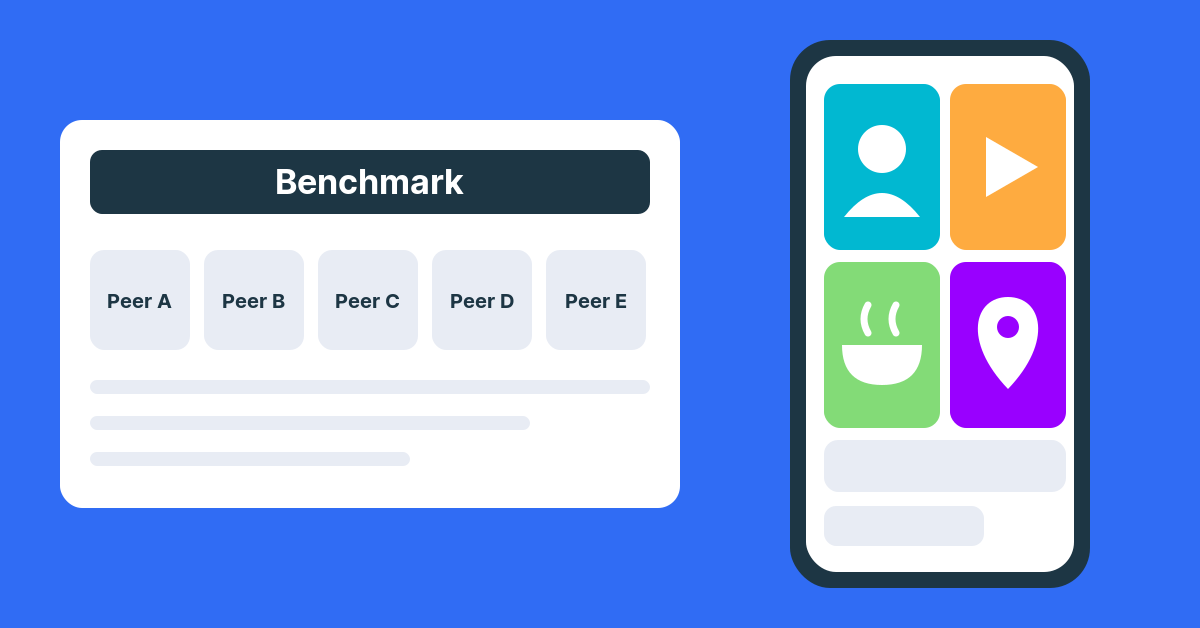
The ten-second competitor list
Ask a team who their competitors are and you'll get the list in about ten seconds. Same names, same order, probably the same slide they used last year. It's a useful list for pricing and positioning. It tells you very little about where your customer's attention goes.
Now ask who their customer follows all day, and watch the category quietly leave the room. Some of the creators, shows and channels winning that attention sell nothing like what you sell.
Your audience decides who you're really up against, and they never see your benchmark slide when they do.
Your customer grades you against their whole feed
Think about where your customer's attention goes in a day. A creator they've followed for years. A show they're halfway through. A newsletter, a travel account, a recipe channel. Somewhere in that mix is an ad or a post from you, and it gets a moment before the thumb moves on.
Whatever came right before it sets the bar. Your category is a small part of that comparison, because the content competing for that moment comes from everywhere. The fight is for attention, and the winners come from every category.
Most competitive benchmarks haven't caught up with this.
What a real follow list looks like
The usual competitive set is built from the inside out. Someone lists the companies they bump into at pitches and trade shows, adds the two or three that keep taking share, and calls it the landscape. Every name on it is a company that sells what you sell. It describes where the industry gathers, which is a different place from where your customer spends the day.
Read an audience across categories and the category stops being the center of the picture. What shows up instead is whatever that audience gravitates toward: interests, brands, creators, shows. For one audience, the list might include a travel creator, a streaming drama, a cooking channel and a lifestyle account. That example is illustrative, not client data, but it's the kind of list the read returns, and it doesn't look like anything on a benchmarking slide.
That list is the real competitive set, and it's much longer than the one on the slide. A raw read of an audience returns thousands of signals, each one an interest, a brand, a creator or a show. Nobody can benchmark thousands of things, so the work is turning them into something a team can use.
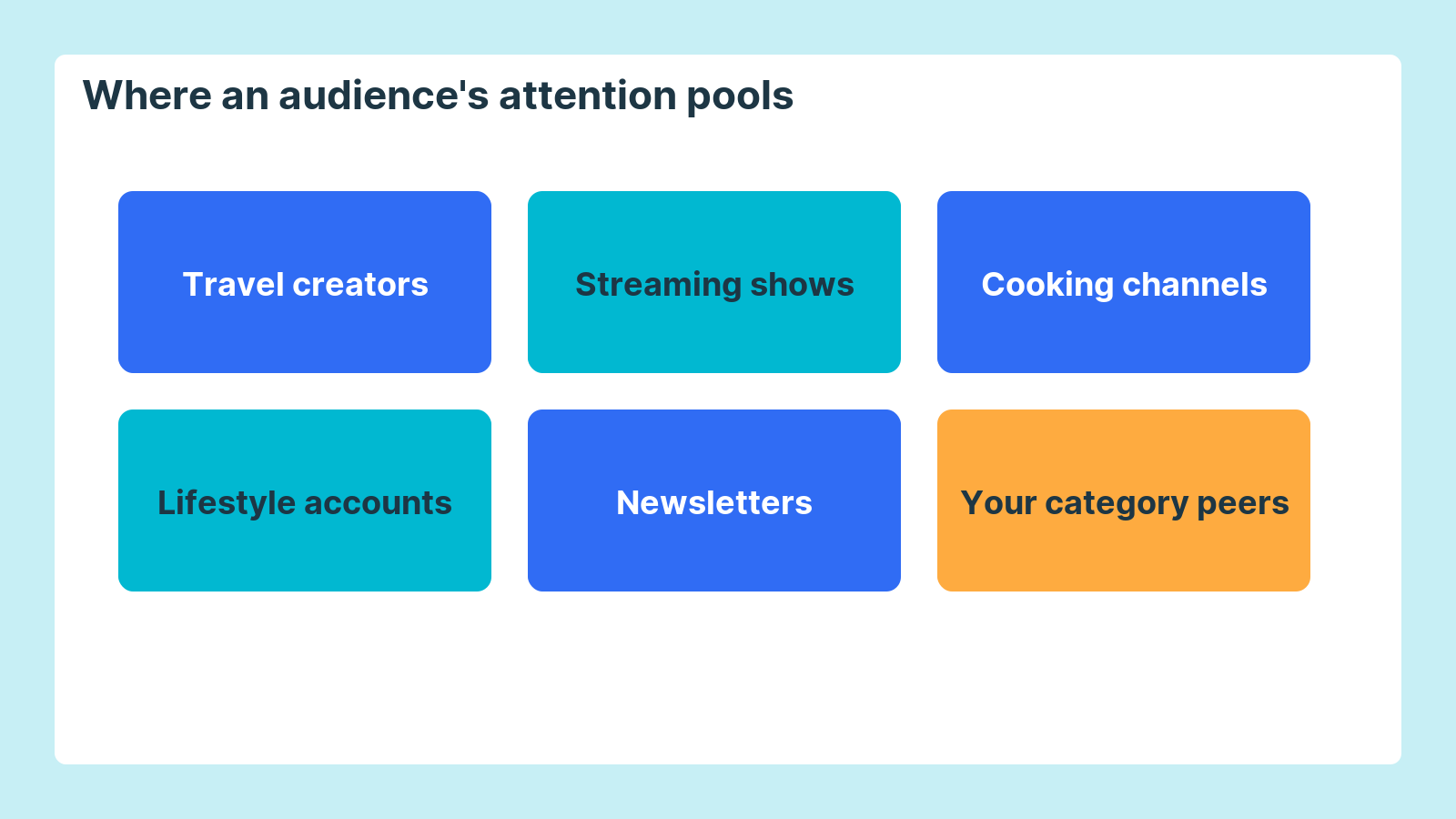
Your category peers are one pool of attention among many.
Telling a signal from a famous name
A huge brand that most of the internet follows will show up in almost any audience's list. That doesn't make it a competitor for yours. Follower counts measure reach, and reach is the wrong filter here.
The better filter is an index. Each interest, brand, creator or show gets scored against a baseline, where 100 is the average person. A score of 200 means your audience is twice as likely as the average person to follow it. Anything near 100 is background, and anything well above it is something your audience leans toward.
Take two hypothetical examples. The numbers are illustrative, not client data. A household-name brand scores 105 for your audience. A mid-sized creator scores 310. The brand is bigger, but the creator tells you far more about where your audience's attention goes.
Without that baseline, a benchmark set tends to be whoever is biggest. With it, the set is whoever your audience actually leans toward.
From thousands of signals to a shortlist of attention spaces
Those thousands of signals cluster naturally. A group of interests, a few brands and a handful of creators will often point at the same space. These are attention spaces, and the creators, brands and shows inside them are your attention competitors. An audience read boils down to a shortlist of spaces. Instead of comparing yourself against one-off data points, you compare yourself against the places where attention pools.
Then comes a pressure test. A real attention space shows up in more than one kind of signal: interests, brands, creators and shows. Say a cooking space turns up only as one popular creator. That's more likely a flash than a pattern. If it also shows up as an interest, as several brands and as several creators, it's a real pool of attention, and it's probably where your audience lives.
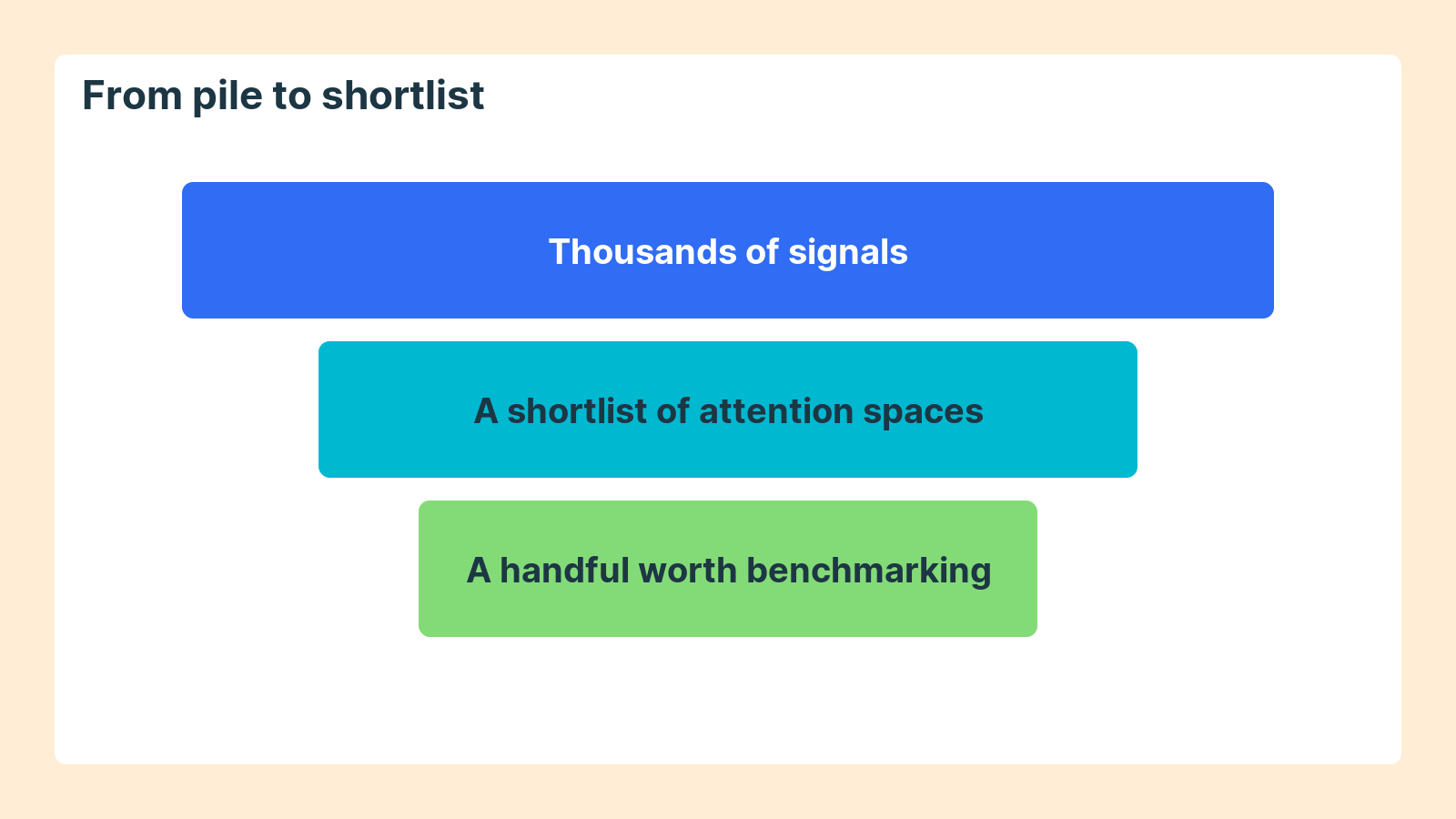
Thousands of signals narrow to a shortlist of attention spaces, then to a handful worth benchmarking.
Which spaces are worth benchmarking
Not every high score is worth chasing. Some spaces are tiny, some are closed communities that reject brand presence on sight, and some are tied to a moment that has already passed. The index tells you where your audience leans. Judgment tells you which of those places you could actually show up in without being a tourist.
Then check the size. Pick spaces that are strongly indexed and big enough to matter, because a space that's too small has nothing to teach you. A useful rule of thumb is to ask whether you could name three specific things from that space last month that your audience talked about. If you can't, it's probably too small or too quiet to learn from.
The attention competitor with the most to teach you is often a mid-sized one that a particular audience treats as its own. The largest name on the list rarely plays that role.
What the rest of the feed can teach you
A category-only benchmark can show you what the rest of the category does, which is often what you already do with minor variations. Everyone in a category tends to watch the same rivals and borrow from the same playbook, so ideas nobody in the category has tried never show up in the set. When your whole set is peers, the best you can do is match them.
A set that includes attention competitors gives you different raw material. A streaming service teaches you how a cliffhanger holds attention. A creator teaches you how a hook works in the first two seconds. A recipe channel teaches you what a repeatable, saveable format looks like. Most of those lessons don't live in your category, and your audience is on the receiving end of all of them.
Timing works the same way. Brands in the same category often launch around the same seasons, in the same tone. An attention competitor runs on its own rhythm. A creator who posts three times a week sets a different sense of cadence than a brand posting three times a month, and your audience has absorbed that rhythm as normal. Content that arrives at a slower tempo can feel slow before anyone has read a word.
In practice, a teardown looks like this. Take three hypothetical attention competitors: a streaming show, a creator channel and a lifestyle account. The show ends every episode on an open question, so its format is the cliffhanger. The creator opens every video with the payoff in the first two seconds, so its hook is the result. The lifestyle account posts the same repeatable format every Tuesday, so its audience knows when to come back. Set side by side, the three give you things to test in your own content that no category peer would.
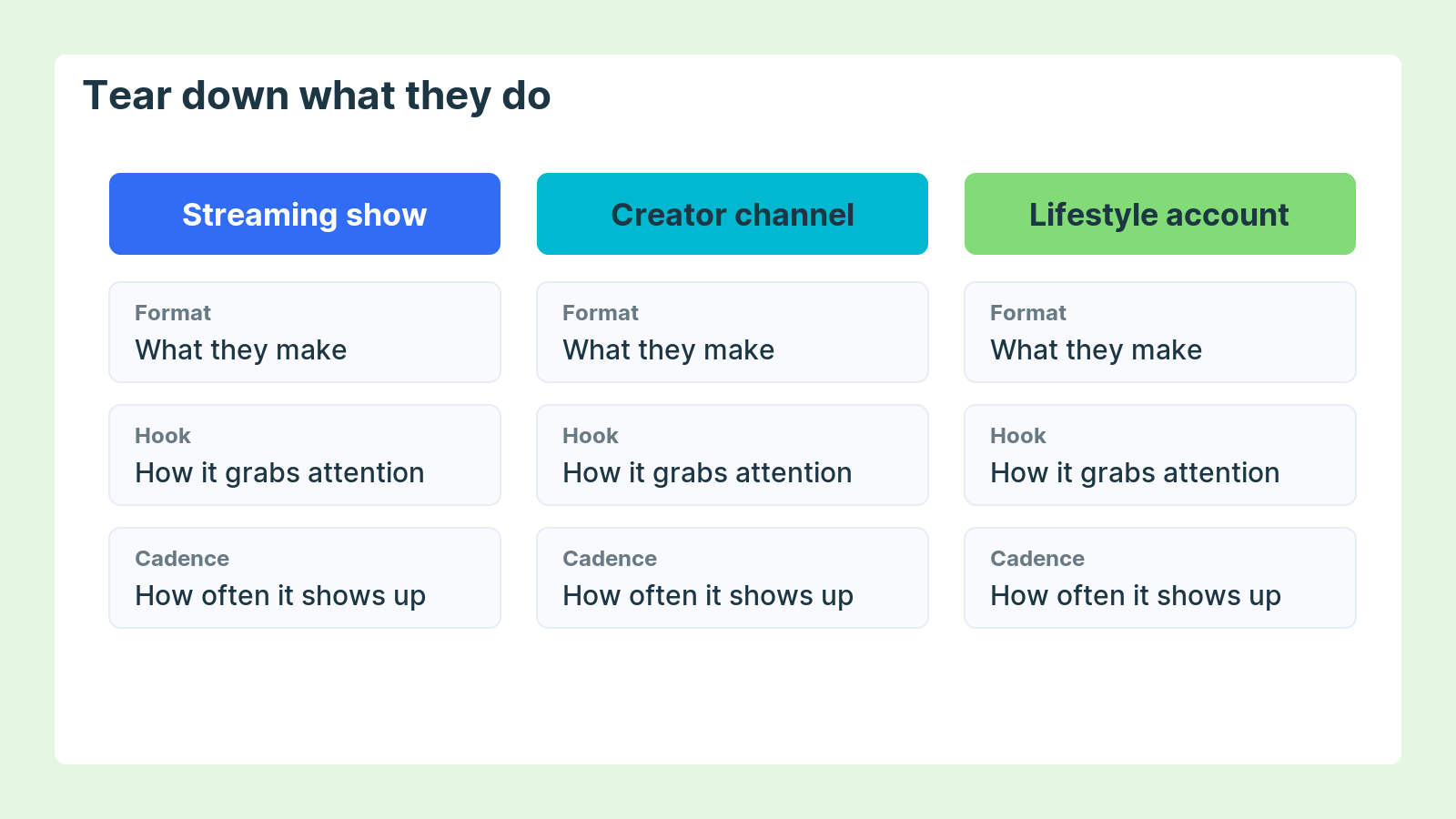
Illustrative teardown: three attention competitors compared on format, hook and cadence.
Four moves for your next benchmark
None of this requires throwing out the competitor set you have. Your category peers still matter for pricing, positioning and share. They just stop being the only comparison.
Build a wider set. Start from the attention competitors your audience actually follows, and keep your category peers in it as one part of the picture.
Tear down what they make. Look at the formats, hooks and cadence of the attention competitors on your shortlist. This is where the lessons from the last section come from.
Brief from the spaces your audience scores high on. Give a creator a brief built on the world their audience already lives in and the work tends to read as native. Give them a brief built on your category's conventions and it tends to read as an ad.
Revisit the set on a schedule. Quarterly is a reasonable starting point. Most of the set should carry over from one pass to the next, so later passes can focus on what moved. Attention moves. The spaces that pooled your audience last year may have drained, and a set you built once and left alone goes stale without announcing it.
The slide you should redraw
Go back to the competitor slide, the one that takes ten seconds to recite. Your customer grades you against everything on their feed, and your category is a small part of it.
Redraw it with two lists side by side: the category peers you've always tracked and the attention competitors your audience actually follows. The first list explains the market, the second explains your audience, and together they show where your brand sits in each. Some of the names on the second list won't sell anything like what you sell. They're still competing for your customer's attention.
Redrawing the slide once is the easy part. Reading thousands of signals down to the handful that move your audience, and keeping that read current as attention shifts, takes ongoing work. That's what an outside read is for. If you'd like to see what your own audience's real set looks like, book a chat.